












The weed available today isn’t the weed people grew up on. Decades of breeding and concentrated products have pushed THC levels far higher than they used to be, and stronger THC means stronger effects, including panic attacks and, in some people, temporary psychosis.
Panic attacks tend to hit fast, often after getting too high too quickly. Psychosis is rarer, shows up more in heavy long-term users or people with underlying vulnerability, and looks very different. Here’s how to tell them apart and what to do.
Why Does Weed Hit So Much Harder Than It Used To?
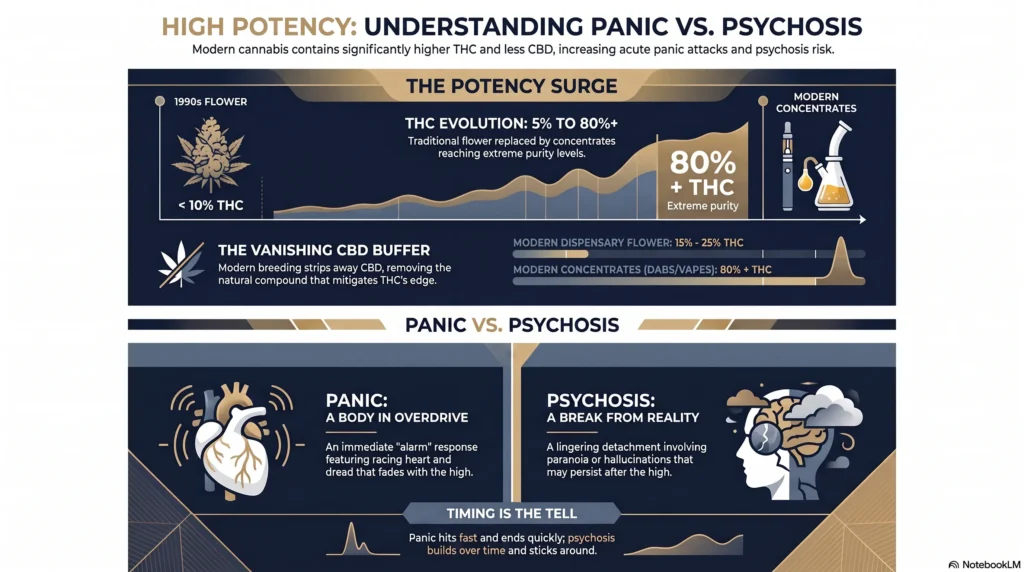
The flower people smoked in the ’90s often had THC in the single digits. A lot of what’s on dispensary shelves now runs 15 to 20 percent or higher, and concentrates, wax, shatter, dabs, vape carts, can climb past 80 percent [1]. This drastic increase in THC produces a different drug experience entirely.
Selective breeding, indoor growing, and the race between producers to advertise the highest numbers have all pushed potency up year after year. And here’s the part that catches longtime users off guard: tolerance built on old-school flower doesn’t necessarily protect you from a modern concentrate. You can be a 20-year smoker and still get blindsided by a dab pen, because your body has never actually dealt with THC at that concentration before.
Older weed also tended to carry more CBD, the compound that takes some of the edge off THC. Modern high-THC products are often bred to strip CBD out in favor of raw potency, which means there’s nothing in the mix softening the ride [2].
Can Getting Too High Give You a Panic Attack?
Yes, and this is far more common than psychosis. If you’ve ever greened out, taken too big a hit, eaten an edible that crept up on you, or hit a concentrate harder than you meant to, you may have felt it: your heart pounding, a flood of anxiety, and the sudden certainty that something is very wrong.
That’s a panic attack, and high-THC products are notorious for triggering them [3]. The signs usually come on fast and hard:
- Racing or pounding heart
- A wave of dread or fear, sometimes feeling like you’re dying
- Sweating, shaking, or chills
- Chest tightness and shortness of breath
- A feeling of unreality or detachment (sometimes called depersonalization or derealization)
The good news: as terrifying as it feels in the moment, a cannabis panic attack isn’t dangerous, and it passes. The intensity fades as the high wears off. It tends to hit hardest when you’ve taken in a lot of THC quickly, which is exactly what modern products make easy to do without realizing it.
What Does Cannabis-Induced Psychosis Actually Look Like?
Psychosis is a different animal. A panic attack is your alarm system firing too hard. Psychosis is a break from reality; your mind starts treating things that aren’t real as real.
It’s less common than panic, and it tends to build differently. Rather than coming on in a single overwhelming wave, it more often shows up in heavy, frequent, long-term high-potency use or in someone who carries an underlying vulnerability [4].
Signs of cannabis-induced psychosis can include:
- Paranoia that doesn’t let up, a persistent sense that people are out to get you
- Hearing or seeing things that aren’t there
- Beliefs that feel completely true to you but don’t match reality
- Disorganized or jumbled thinking and speech
- Feeling disconnected from yourself or the world in a way that lingers after the high should have worn off
The key difference: a panic attack fades when you come down. When paranoia, strange beliefs, or disconnection stick around between sessions or keep getting worse, that’s a sign something deeper is going on and it’s time to take it seriously.
Does This Happen to Everyone, or Just Some People?
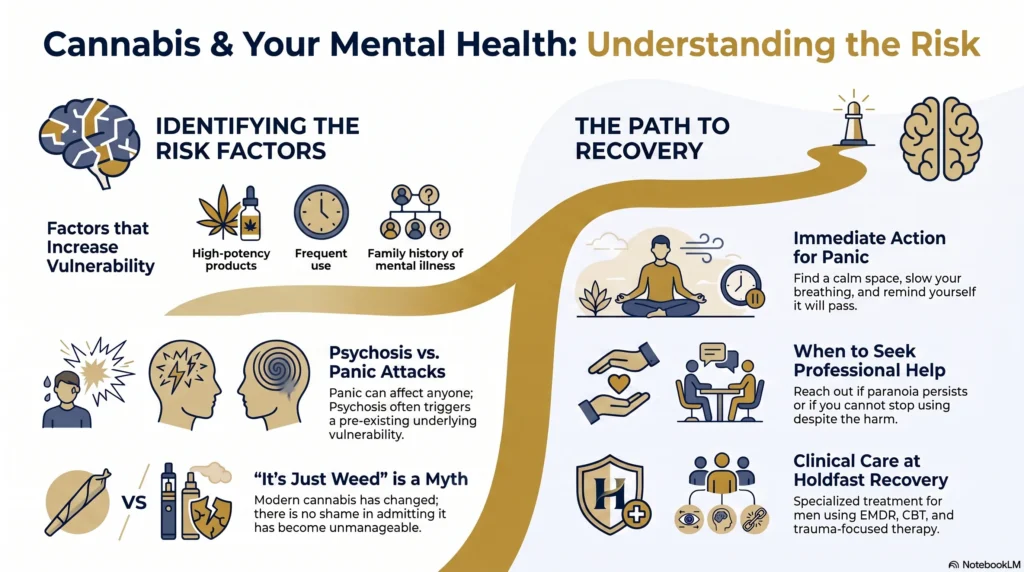
Not everyone. Plenty of people use cannabis without ever having an experience like this. But certain things can influence the likelihood, such as using very high-potency products, using heavily and often, starting young, and having a personal or family history of mental illness [5]. None of these guarantees a problem; they’re just risk factors, the same way some people can drink casually and others can’t.
The truth is that THC doesn’t create psychosis out of nothing in most people, but it can pull the trigger on a vulnerability that was already there [4]. For panic attacks, the bar is much lower; anyone can have one if they get high enough, fast enough.
What Should You Do If This Is Happening to You?
If it’s a panic attack in the moment, find a calm, safe space, slow your breathing, remind yourself it will pass, and ride it out. It always ends.
If it’s bigger than that, if the paranoia or the disconnection isn’t going away, if you’re scared by what your mind is doing, or if you’ve noticed you can’t seem to stop using even though it’s hurting you, that’s worth paying attention to.
A lot of guys talk themselves out of getting help here, telling themselves it’s just weed; they should be able to handle it. But the weed changed, and there’s no shame in admitting it’s gotten the better of you.
Getting Honest About Cannabis at Holdfast Recovery
At Holdfast Recovery in Prescott, Arizona, we work with men who’ve reached a point where something that used to feel manageable no longer is.
We treat the whole picture, not just the substance. Our team combines real clinical care, including EMDR, CBT, and trauma-focused therapy, with a community of men who get it, in an environment built for the kind of honesty that actually changes things.
If any of this hit close to home, reach out. The first step is a conversation.
Sources
[1] National Institute on Drug Abuse. (2024). Cannabis potency data. National Institute on Drug Abuse.
[2] Hutten, N. R. P. W., et al. (2022). Cannabis containing equivalent concentrations of delta-9-tetrahydrocannabinol (THC) and cannabidiol (CBD) induces less state anxiety than THC-dominant cannabis. Psychopharmacology, 239(11), 3731–3741.
[3] Zvolensky, M. J., et al. (2010). Marijuana use and panic psychopathology among a representative sample of adults. Experimental and Clinical Psychopharmacology, 18(2), 129–140.
[4] van der Steur, S. J., et al. (2020). Factors moderating the association between cannabis use and psychosis risk: A systematic review. Brain Sciences, 10(2), 97.
[5] Centers for Disease Control and Prevention. (2024). Cannabis facts and stats. Centers for Disease Control and Prevention.