












If you have ever watched someone you love insist they have not been drinking when the evidence is right in front of you or deny that alcohol is a problem while losing everything around them, you know how disorienting it is. It can feel like gaslighting, contempt, and make you question your perception of reality.
This article is for the family member trying to understand what they are witnessing. It is also for the man in recovery who has started to look back at his own years of denial and wonder how he could have believed what he did.
Is an Alcoholic Lying on Purpose?
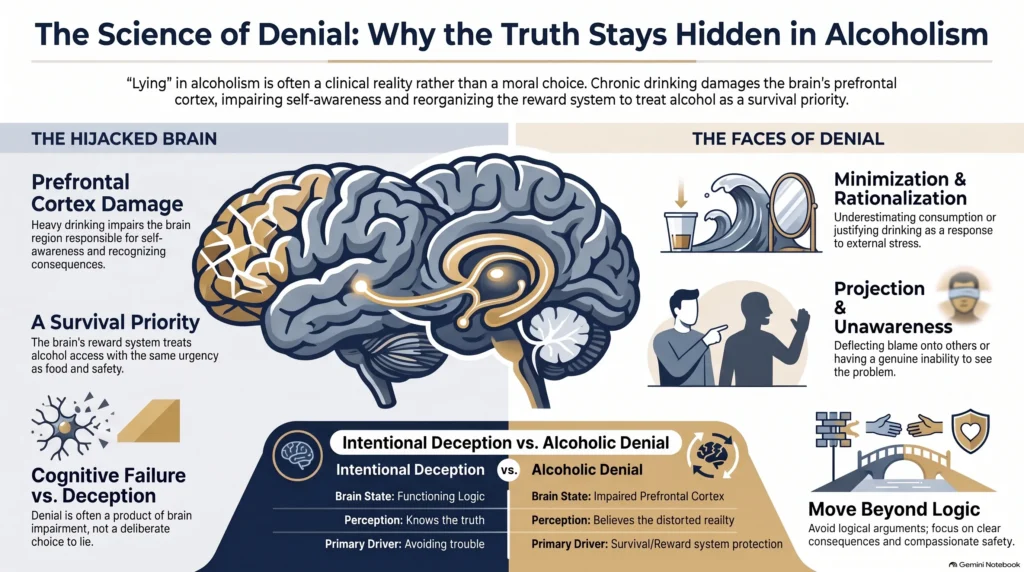
Sometimes yes. But often, what looks like deliberate deception is something more complicated and more difficult to confront than a simple choice to lie. Research shows that denial in alcohol use disorder correlates with impaired executive function, verbal memory, and the capacity for insight [1].
In other words, the part of the brain responsible for assessing one’s own situation, integrating evidence, and drawing conclusions is directly damaged by chronic alcohol use.
Long-term heavy drinking affects the prefrontal cortex that governs self-awareness, impulse control, decision-making, and the ability to recognize consequences [2]. When that system is impaired, a person’s capacity to accurately perceive their behavior is compromised.
They are not always lying in the way a person lies when they know the truth and choose to say something different. They are sometimes operating with a version of reality that their damaged brain has constructed and that feels completely accurate to them. That is not an excuse, but it is a clinical reality that changes how families and loved ones need to approach the conversation.
What Is Denial in Alcoholism?
Denial in addiction is not a single thing. It shows up in several patterns.
Minimization: Two drinks becomes one. A nightly habit becomes occasional. The amount consumed is consistently underestimated, not always intentionally, but because the brain has normalized a level of consumption that others find alarming.
Rationalization: The drinking is explained rather than addressed. The stress at work. The difficult marriage. An injury. The reason is always present and always real enough to feel like justification.
Projection: The problem is you, the person raising concern, not the drinker. You are either too sensitive and controlling, or you simply do not understand. This pattern is painful for families because it converts the act of expressing concern into being the problem.
Genuine unawareness: Research shows that alcoholic denial is sometimes more a product of cognitive failure than a conscious choice to reject the truth [1]. The person cannot see what others see. It is not a deliberate choice—the prefrontal damage produced by years of heavy drinking has impaired accurate self-assessment.
Why Does the Brain Protect the Addiction?
Addiction reorganizes the brain’s reward and motivation systems around drugs and alcohol. The brain treats continued access to alcohol as a survival priority with the same motivational force it uses for food, safety, and connection [3].
If the brain can construct a version of reality in which the drinking is not a problem, it protects the behavior that feeds the reward system. The lying, minimizing, and deflection are all downstream consequences of what addiction does to the reward and self-assessment systems of the brain.
What This Means for Families
Understanding the neurology of denial does not mean accepting behavior that is harmful. It means approaching the conversation differently. Confrontation that aims to prove the person wrong rarely works, because the problem is not a logical one.
A man whose prefrontal cortex has been compromised cannot be argued into accurate self-perception. What works is a combination of consistent, compassionate, and clear consequences [1].
The goal is not to win the argument but to create the conditions where your loved one feels safe enough to process the reality he has been avoiding.
What This Means for the Man in Recovery
If you are in recovery and you are reading this, some of what is described above may sound familiar in a way that is uncomfortable to sit with.
Looking back at the years of minimization, rationalization, and projection is one of the harder pieces of early recovery. Learning that alcohol was distorting your own view of your drinking does not erase what happened.
What it does give you is a framework for understanding yourself that is more accurate and more useful than simply concluding that you are a liar or bad person.
Alcohol Addiction Treatment for Men in Arizona at Holdfast
We work with men who have spent years in denial and their affected loved ones. Our PHP and IOP programs address the cognitive and emotional dimensions of addiction through evidence-based clinical care and a Christ-centered brotherhood that creates the conditions for honest self-examination.
If you are ready to stop managing this and start addressing it, we are ready to connect with you. Rise stronger in recovery today. Contact our admissions team.
Sources:
[1] Fals-Stewart, W. (2002). Addiction denial and cognitive dysfunction: A preliminary investigation. Journal of Neuropsychiatry and Clinical Neurosciences, 14(1), 52–57.
[2] Crews, F. T., & Boettiger, C. A. (2009). Current hypotheses on the mechanisms of alcoholism. Pharmacology Biochemistry and Behavior, 93(2), 199–211.
[3] Koob, G. F., & Volkow, N. D. (2010). Neurobiology of alcohol dependence: Focus on motivational mechanisms. Alcohol Research and Health, 33(1–2), 113–127.